

The most reliable 2027 fuel budgets start with the fleet’s own data: delivery records, fuel card statements, and vehicle-by-vehicle usage. From there, a fleet can plan for a range of prices around the federal forecast and set aside enough to cover the high end.
At the start of this year, a fleet manager setting a 2026 budget had good reason to plan for diesel at about $3.43 a gallon, the U.S. Energy Information Administration (EIA) forecast for the year. By September, the national average was $6.29, and fuel, already one of the biggest lines in the operating budget, had become the line that broke it. The EIA expects some relief in 2027, but after this year, few fleet managers will want to build their whole budget around a forecast.
Fortunately, half of a fuel budget doesn’t depend on the forecast at all. Gallons come from a fleet’s own operations, and for fleets that fuel with Booster, every delivery is already recorded by vehicle and location. Fleets can also lower their exposure before prices move by leaning on cheaper fuels and renewable diesel or claiming fuel tax credits on off-highway equipment.
Why Does a Better Fuel Budget Start With Better Data?
A fuel budget built from last year’s spend plus a bit for inflation blends two very different numbers: what fuel costs and how many gallons the fleet burns. Price gets most of the attention, but no fleet can control what diesel costs. What a fleet can control is how many gallons it uses, which vehicles burn them, and what goes in the tank.
Price per Gallon
Price is the number everyone watches, and it might seem like the simple part. The EIA’s October 2026 Short-Term Energy Outlook is the most defensible starting point. It expects retail diesel to average about $4.50 a gallon in 2027 and gasoline just under $3.60, with diesel staying above $4 because the EIA expects diesel inventories to stay below their 2021–2025 average. That forecast still needs a few adjustments before it goes into the budget, plus a few costs it doesn’t capture:
- Factor in region: National averages hide big local differences, and the EIA publishes weekly retail prices by region.
- Price each fuel separately: Gasoline, diesel, and renewable diesel move on different paths.
- Use a fully loaded price: The figure that belongs in the budget is the all-in cost per gallon, including taxes and any delivery or service fees. Federal excise tax alone adds 24.4 cents a gallon to diesel and 18.4 cents to gasoline, and state taxes vary widely on top of that. EIA figures are pump averages with taxes already included, while many delivery contracts are priced off a wholesale index plus a fee, so the two aren’t directly comparable until both are fully loaded.
- Count the hidden costs: Driver time at the pump, fuel card reconciliation, and card misuse never appear on a fuel invoice. Spread across the fleet’s gallons, they raise the true cost of every fill-up and still belong in the budget.
Where Every Gallon Goes
Gallons are the other half of the equation. Every gallon has a fuel type, a source, a location, and a job, and each one can change what that gallon really costs. Diesel and gasoline are priced differently. A gallon bought at a retail pump carries different costs than one delivered on site. Prices and taxes shift from one yard or region to the next. And a gallon that moves a working truck does more for the business than one burned idling or driving to the station.
Tracking at that level answers the questions that actually move a budget: which vehicles and sites drive spend, whether a vehicle should be running a different fuel, and whether fuel is coming from too far away. It also sharpens the forecast, because each kind of gallon can be priced on its own instead of being averaged into one number. The most accurate forecasts build gallons up from the fleet’s own vehicles, miles, and hours:
- On-road vehicles: Annual miles divided by miles per gallon, by vehicle class
- Off-road equipment and generators: Run hours multiplied by gallons per hour
- Fleet changes: Vehicles added or retired, new locations, and seasonal swings
Consider a landscaping company running 15 diesel trucks, each covering 20,000 miles a year at 10 miles per gallon. On paper, that fleet needs 30,000 gallons. In practice, those gallons aren’t all alike. A truck that idles at job sites burns more than its miles suggest. A crew that fills up at a retail station on the way to a job pays different costs than one fueled overnight in the yard. And two yards in different counties can see different prices and taxes. The strongest data for sorting all of that out is the fleet’s own history, but many fleets don’t track fuel at the per-gallon level.
Fleet managers can piece that history together themselves. Fuel card statements show where and when each fill-up happened, telematics and maintenance records show miles and run hours, and paper logs fill some of the gaps. Matching each gallon to a vehicle, a site, and a fuel type in a spreadsheet works, but it takes real grunt work and has to be redone every time new data comes in. Once it’s together, a fleet manager can spot vehicles worth optimizing and spending worth cutting.
Booster customers get that view without the spreadsheet. Every delivery is recorded by vehicle, location, and fuel type, and the fleet dashboard shows vehicle-by-vehicle data and full fleet reports side by side, with fuel card transactions and telematics data alongside delivery records.
Put the two halves together and the fleet has a base budget built from its own numbers. At a $4.50 base price, the landscaping fleet’s 30,000 gallons come to $135,000, and every $0.50 change per gallon adds or subtracts $15,000.
How Can Fleets Optimize Their Fuel Usage in 2027?
No fleet manager can predict what diesel will do in 2027, but a fleet that knows where its gallons go has plenty of ways to soften the blow if prices spike again. Most of them start before the first gallon of the year is bought.
Diversify the Fuel Mix
- Shift to the cheaper fuel: Once a fleet knows which vehicles burn which fuel, and how much, it can lean on whichever fuel is cheaper at the moment, and the gap can be wide. In September 2026, diesel averaged $6.29 a gallon nationally while gasoline averaged $4.35. Booster delivers gasoline, diesel, renewable diesel, and biodiesel blends, and its Smart Tankers can carry more than one fuel type per trip, so a fleet can change its mix without adding suppliers or deliveries.
- Add renewable diesel: Usage data shows which diesel vehicles and sites could add renewable diesel as a second fuel to price against. It meets the same ASTM D975 specification as petroleum diesel and works as a drop-in replacement in the same engines and tanks. Booster is the exclusive mobile fueling partner of Chevron’s Renewable Energy Group, which keeps renewable diesel available to fleets as supply shifts.
Lock In Price & Supply
- Know which costs are fixed: With per-gallon costs in hand, fleets can compare suppliers on how fuel is priced and which fees stay fixed when the market moves. Booster buys fuel against a market index and keeps its service fees fixed, and per-gallon pricing and fees both appear in the customer dashboard as they post.
- Secure supply ahead of a squeeze: Fleets can line up backup sources before supply tightens, as diesel did through much of 2026, and map where each site’s fuel comes from so one disruption doesn’t stall every location. Booster works with all of the major fuel suppliers across a network of terminals and commits to set purchase volumes in exchange for guaranteed availability.
Recover & Reduce
- Claim fuel tax credits: Clear diesel and gasoline used in qualifying off-highway equipment, such as generators and construction machinery, may be eligible for the federal fuel tax credit, which returns 24.3 cents a gallon on diesel and 18.3 cents on gasoline. Fleets that track which gallons go into off-highway equipment can build that credit into the budget model. Booster’s customer portal tracks fuel use vehicle by vehicle, which gives fleets the record those claims require.
- Cut wasted gallons: Idle time and off-route trips to the gas station burn fuel that doesn’t move any work forward. Booster’s customer dashboard puts telematics data next to fueling records to show where those gallons go, and fueling on site removes the station detour entirely.
None of these steps make a fleet immune to price swings, but they shrink how much the budget has to absorb when one hits.
How Much Price Swing Can a Fleet Absorb?
Fuel accounts for roughly a fifth of what it costs to run a for-hire truck, according to the American Transportation Research Institute’s 2026 Analysis of the Operational Costs of Trucking. In 2026, retail diesel stayed close to the January forecast for two months, then broke away in March and kept climbing.
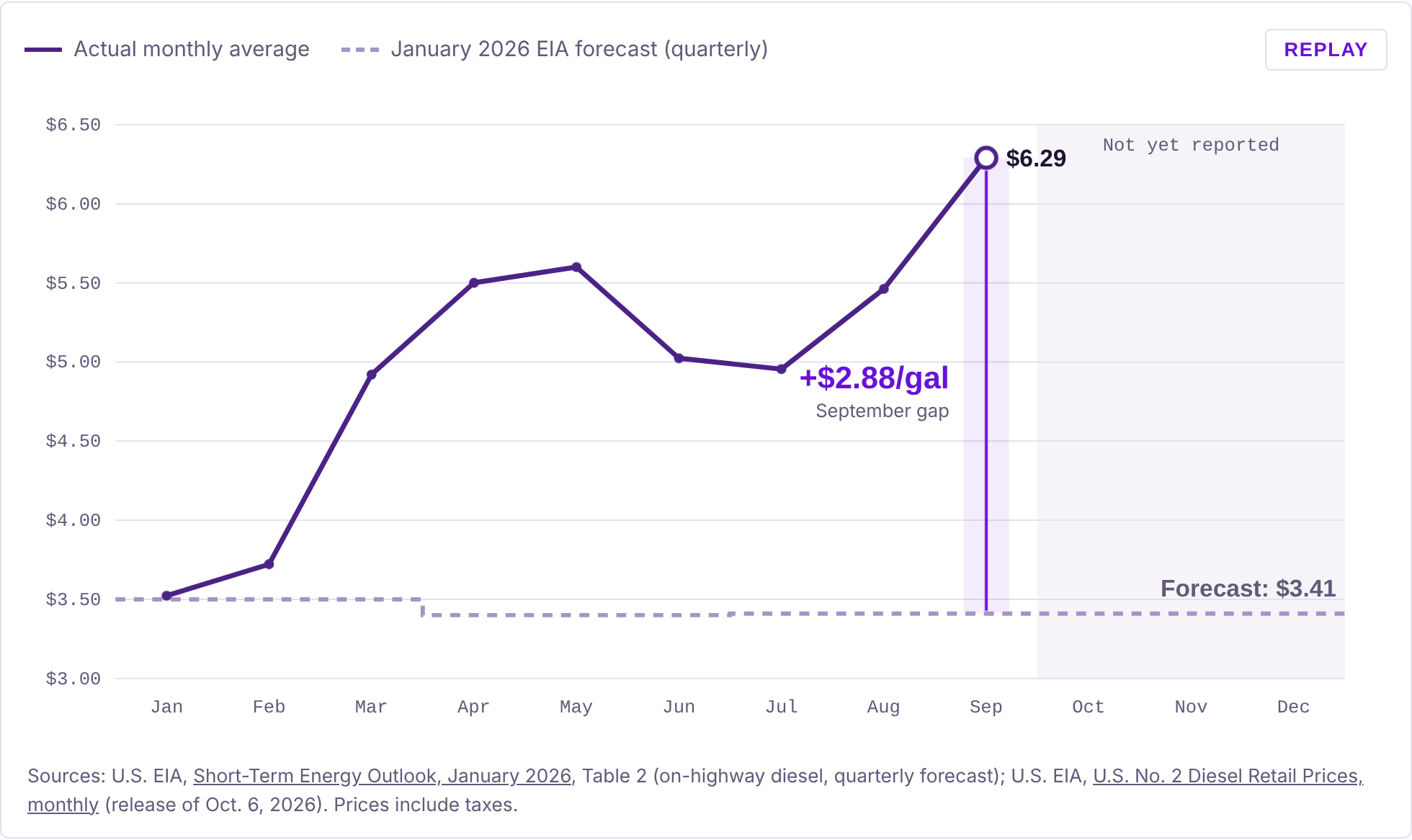
From January through September, diesel averaged about $5.00 a gallon, roughly $1.57 above the January forecast of $3.43. At that rate, the landscaping fleet would overspend by about $47,000 over a year.
That’s the case for budgeting a range instead of a single number, with a contingency line sized from it. Against the $4.50 base, covering a repeat of 2026’s year-to-date average would take about $15,000, and covering September 2026’s $6.29 would take about $53,700. The levers above can bring that number down, and the right amount to set aside depends on how much risk the fleet can absorb.
What Keeps a Fuel Budget on Track After It’s Approved?
Once the year starts, the job shifts to catching problems early, and that means tracking the same gallon data used to build the budget, not just the price. Re-forecasting against each monthly EIA outlook gives a natural checkpoint, and tracking gallons and price separately shows whether an overrun needs an operational fix or a pricing one.
Fleet managers can keep that same spreadsheet running all year, reconciling fuel card statements, delivery invoices, and telematics reports against the budget each month.
In Booster’s customer dashboard, that work is already done: fleet managers can schedule per-location spend reports, set spend thresholds, and see per-gallon pricing and fees as they post, with WEX, Voyager, and Comdata card purchases pulled into the same view.
The diesel price forecast will change many times before the end of 2027. A fleet that knows its gallons, prices a range, and checks its numbers monthly can take each revision in stride instead of rewriting the budget every time.
Building your 2027 fuel budget? Reach out for a complimentary fuel analysis, and our team will help you build next year’s gallon forecast from your own fleet’s data.