
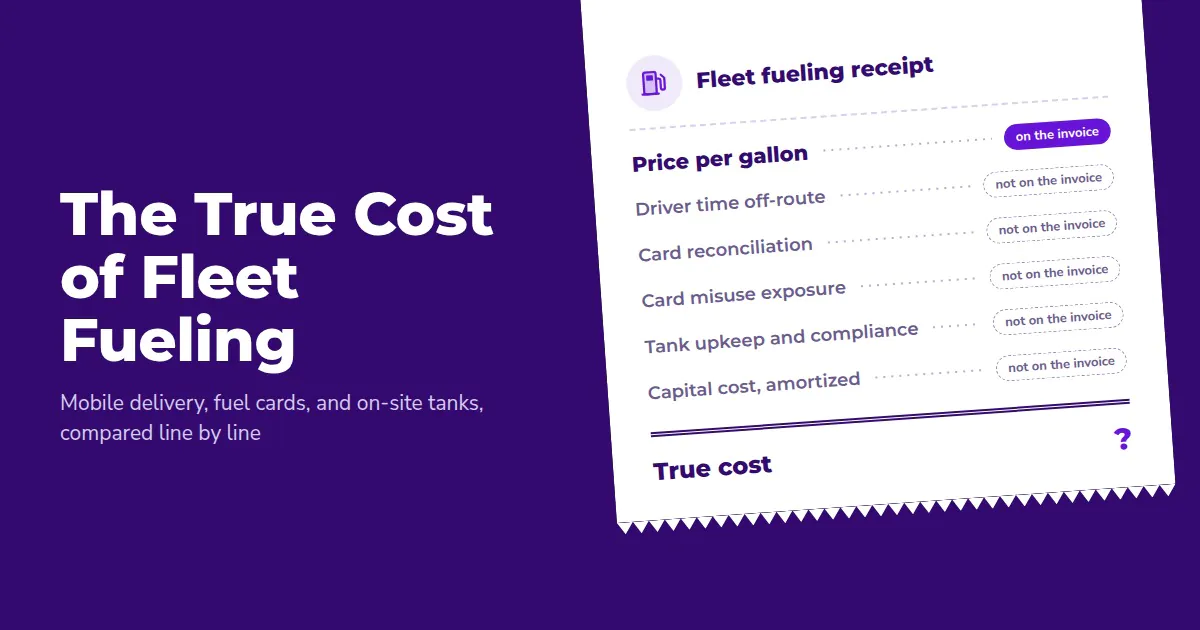
For many fleets, the fueling conversation starts and ends with the price per gallon. But that’s only one line in a much longer ledger. Labor, downtime, compliance, and theft all show up in a fleet’s fueling costs before the invoice does, and each fueling model – fuel cards, on-site tanks, and mobile delivery – carries a different mix of them. Understanding those differences, rather than chasing the lowest price, is what actually protects a fleet’s budget over time.
What Does Fleet Fueling Actually Cost?
Every fueling model carries the same four cost categories:
- Fuel price
- Labor cost
- Capital or administrative overhead
- Exposure to theft, fraud, or downtime
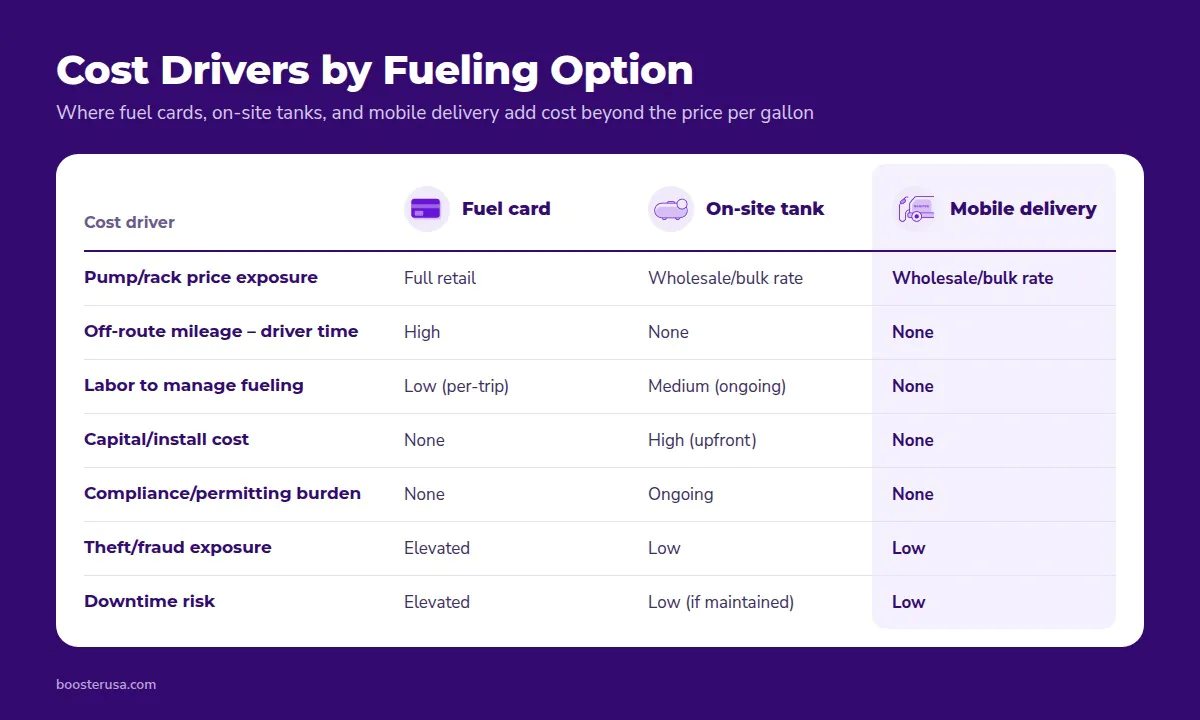
What differs is how much of each of these categories a fleet actually bears. Fuel price is often where the three models differ least, since on-site tanks and mobile delivery both typically draw on wholesale or bulk pricing, while fuel cards expose drivers to full retail rates. The real variance shows up in the other three categories: the labor a fleet spends getting fuel into vehicles, the capital and compliance overhead of maintaining infrastructure, and how exposed each model is to theft, fraud, or downtime. Those categories, more than the price per gallon, are what separate a fueling program that quietly drains a budget from one that protects it.
How Much Does a Fuel Card Program Cost a Fleet?
Fuel cards remain a familiar, flexible option for many fleets. They come with a low up-front cost, are easy to distribute across a team, require no infrastructure to install, and give drivers the freedom to fuel at any participating station along a route.
That flexibility does come with a few trade-offs. Drivers typically pay full retail price at the pump rather than a negotiated bulk rate, and each stop adds a short detour from the route. That adds up: Booster’s own driver-time research calculates that drivers, on average, spend roughly 90 hours annually on refueling trips, the result of about 15 stops a month, which at industry-average driver pay translates to more than $2,200 per driver in labor cost.
Meanwhile, it is worth pairing any fuel card program with active monitoring, as industry research shows fuel card misuse, theft, and unauthorized spending averages 5-10% for businesses that rely on individual fueling trips. And these programs come with an administrative layer built in: someone has to reconcile card activity across a fleet, flag unusual purchases, and verify that reported fill-ups match actual use. Plenty of fleets manage this well at a small scale, though the time required tends to grow with fleet size, geographic coverage, and business growth.
If you’re considering a fuel card program, think about:
- Full retail pricing: convenient, though typically without a bulk or wholesale rate advantage
- Off-route mileage and driver time: flexible fueling, with each trip adding a short detour from the route
- Fraud exposure: easy to deploy fleet-wide, with usage that benefits from active monitoring (5-10% industry misuse average)
- Administrative overhead: manageable at smaller scale, with reconciliation time that grows alongside the fleet
How Much Does an On-Site Fuel Tank Cost to Run?
On-site tanks appeal to fleets that want direct control over their own fuel supply. Fuel is available on-site whenever it’s needed, there’s no per-trip retail markup, and for a fleet with large, consistent fuel volume concentrated at one location, that control can be a real advantage.
Owning the infrastructure comes with responsibilities: underground storage tanks are federally regulated under 40 CFR Part 280, which requires secondary containment, corrosion protection, and spill and overfill prevention at installation, along with inspections at least every three years. Above-ground tanks aren’t exempt from oversight either: any facility storing more than 1,320 gallons is required to maintain a federal Spill Prevention, Control, and Countermeasure plan. States can, and often do, layer additional inspection and licensing requirements on top of the federal floor.
The scale of that regulatory framework reflects real liability exposure. That’s why the financial responsibility requirement exists in the first place: the EPA reports more than 533,000 active petroleum underground storage tanks in service nationwide, and more than 581,000 confirmed releases from UST systems since the program’s 1984 inception, as of the agency’s most recent fiscal year data. Owners and operators can satisfy that requirement a number of ways, including commercial insurance, a self-insurance financial test, a corporate guarantee, a surety bond or letter of credit, or a trust fund administered by a third party. Local governments have a few additional options tailored to their structure, including a bond rating test. Inspections, containment upkeep, and financial responsibility all recur for as long as the tank is in the ground, so it helps to budget for them as an ongoing part of the program rather than a one-time setup cost.
Alongside the regulatory considerations, fleets with on-site storage have to consider flexibility. If at any point they diversify their fleet inventory, they may require additional fuel types to keep them running. For mixed fleets like this, one on-site fuel tank is not enough. They have to have a tank for each fuel variety and that comes with costs, regulation, and the basic need for more space.
If you’re considering an on-site fuel tank option, think about:
- Full control over fuel supply and availability, with no per-trip retail markup
- High up-front capital cost to install and permit
- Ongoing compliance: inspections at least every three years, corrosion protection, and containment requirements
- Financial responsibility requirement: insurance, bonding, a trust fund, or another EPA-approved mechanism to cover potential cleanup costs
- State-level requirements that can exceed the federal floor, adding further inspection and licensing burden
How Does Mobile Fuel Delivery Optimize Your Costs?
Mobile fuel delivery is built to offer the wholesale pricing advantage of owning fuel infrastructure without taking on the capital and compliance responsibilities that come with it. Pricing is typically structured to stay visible rather than surface as a surprise at month’s end, combining a fixed service fee with transparent per-gallon pricing. For fleets running more than one fuel type, mobile delivery can also collapse what would otherwise be separate fueling systems into one.
Booster provides customized quotes based on location, fuel type, and delivery frequency, and a mobile energy consultant evaluates a fleet’s existing fuel consumption and fueling process to determine whether on-site service would reduce costs before a contract is signed. Fixed service fees and per-gallon pricing are displayed directly in Booster’s customer dashboard, and the platform integrates with the fuel card and telematics systems many fleets already run, including WEX, Voyager, and Comdata on the spend side and Geotab, Samsara, and Verizon on the telematics side, so fueling data sits alongside a fleet’s existing operational data rather than requiring a new standalone system. These integrations give clients the best of both worlds – program benefits and transparent pricing and delivery. For mixed fleets, there are no additional trips or additional costs per fuel type. Booster’s Smart Tankers can carry multiple fuel types in a single trip, and clients see the benefits in their invoice.
Mobile fuel delivery also prevents fraud disasters: While industry research indicates fuel card programs can lead to the 5-10% in losses as mentioned earlier, Booster clients using mobile delivery report a notably tighter average of 0.3-0.5 in losses. Closing that gap has meant real savings for individual fleets. One client uncovered more than $45,000 in fuel card misuse when we worked with them on a free fueling analysis, and a global delivery fleet partner that saved more than $30,000 annually after moving to mobile delivery.
If you’re considering mobile fuel delivery, reach out to talk to a member of the Booster team to find out more about how our service is delivered.
Side-by-Side: What Actually Drives the Cost of Each Fueling Model?
Rather than compare a single price point across the three models, which changes every day, it helps to compare the exposures each model creates for a fleet:
Fuel prices have swung dramatically over the last two years. Diesel has already had a wild year: the week of September 7, 2026, the national average hit $5.97 a gallon, the highest the EIA has recorded since it started tracking the series back in 1994. California got hit even harder, climbing to $7.76 a gallon the same week. Now rewind less than a year, and the picture looks totally different: gasoline averaged just $3.10 a gallon nationally across all of 2025. That’s the kind of swing that can make a cost comparison built on this week’s prices useless by the time anyone runs the numbers. What doesn’t move nearly as fast is which fueling model exposes a fleet to fewer of the cost categories above.
Fleet managers can apply the same logic to their own numbers: cost per fueling event is roughly equal to fuel cost multiplied by gallons used, plus labor rate multiplied by time spent off-route, plus any amortized capital cost where applicable.
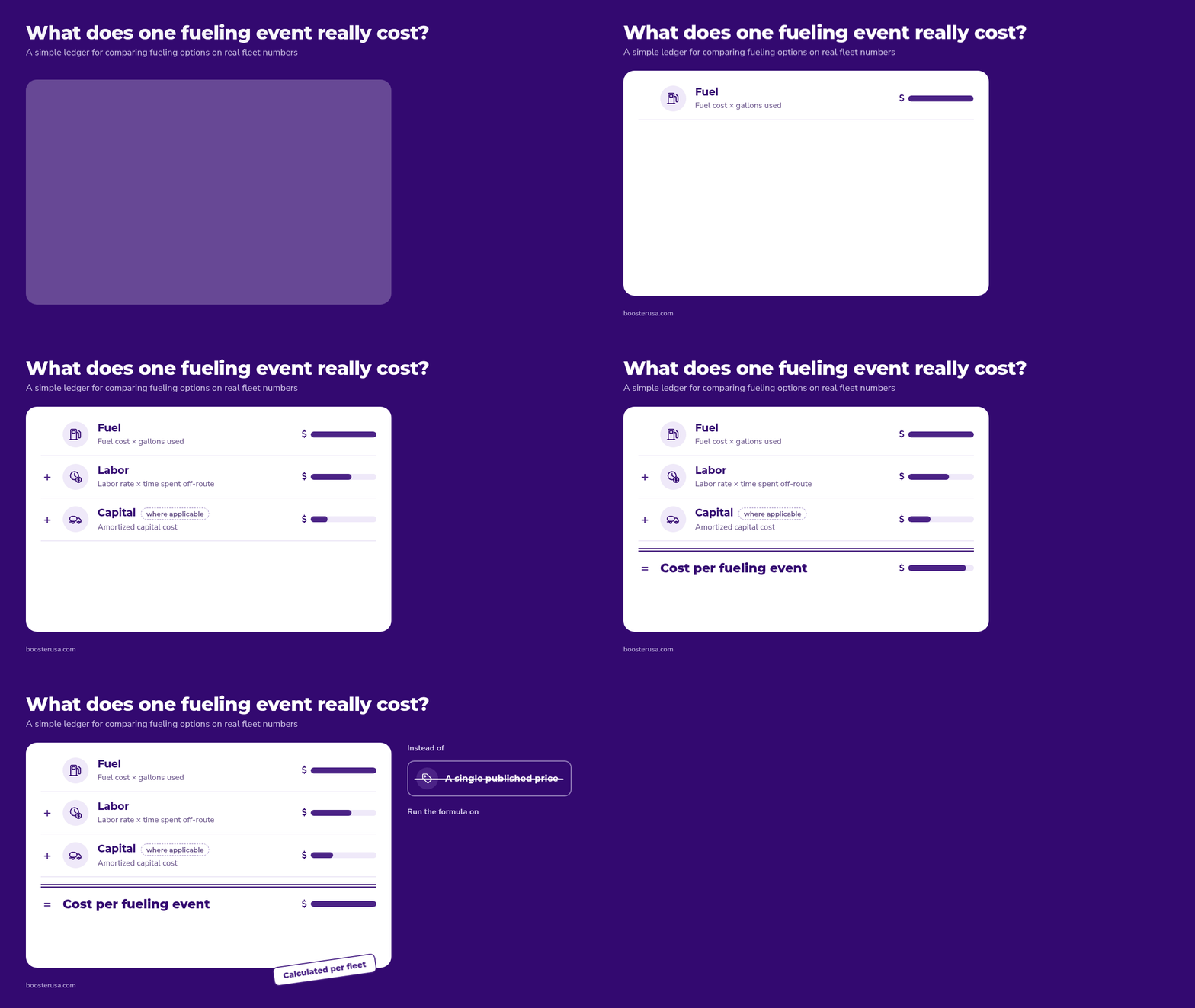
Running this formula against a fleet’s actual fuel volume and costs, rather than a single published price, is what turns this comparison into a decision rather than a guess.
Here at Booster, we believe mobile fueling, which can incorporate many of the same benefits as a fuel card program, is the strongest fit for most fleets. That said, it isn’t the only workable option, and the right model still comes down to how a specific fleet operates, not just its size or fuel type.
Which Model Makes Sense for Which Fleet Size or Use Case?
The right fueling model depends less on fleet size alone than on how a fleet operates. A small, single-location fleet with predictable routes may find a fuel card program manageable, provided fraud monitoring is in place. A large fleet with high, consistent fuel volume at a single yard may have the scale to justify an on-site tank’s capital cost. And a fleet that values eliminating driver downtime, fraud exposure, and compliance overhead in one move, regardless of size, tends to be the strongest fit for mobile fuel delivery.
A few operating patterns tend to point clearly toward one model. Fleets that are actively growing or that run a mix of gasoline and diesel vehicles benefit from mobile delivery’s freedom from infrastructure lock-in: there’s no tank to size for future growth, and no second system to add when a new fuel type joins the fleet. Fleets spread across multiple locations benefit from centralized dashboard visibility that ties fueling data to the rest of their operations, rather than reconciling separate records site by site. And fleets running off-road equipment, construction machinery, generators, or agricultural vehicles that qualify for the federal Off-Highway Business Use Fuel Tax Credit have a specific reason to prefer delivery paired with vehicle-by-vehicle usage tracking: that data is exactly what a tax refund claim needs.
Every fleet’s numbers are different. If your team wants help running this comparison against your own fuel volume, routes, and locations, reach out to a member of the Booster team for a complimentary fuel analysis.