
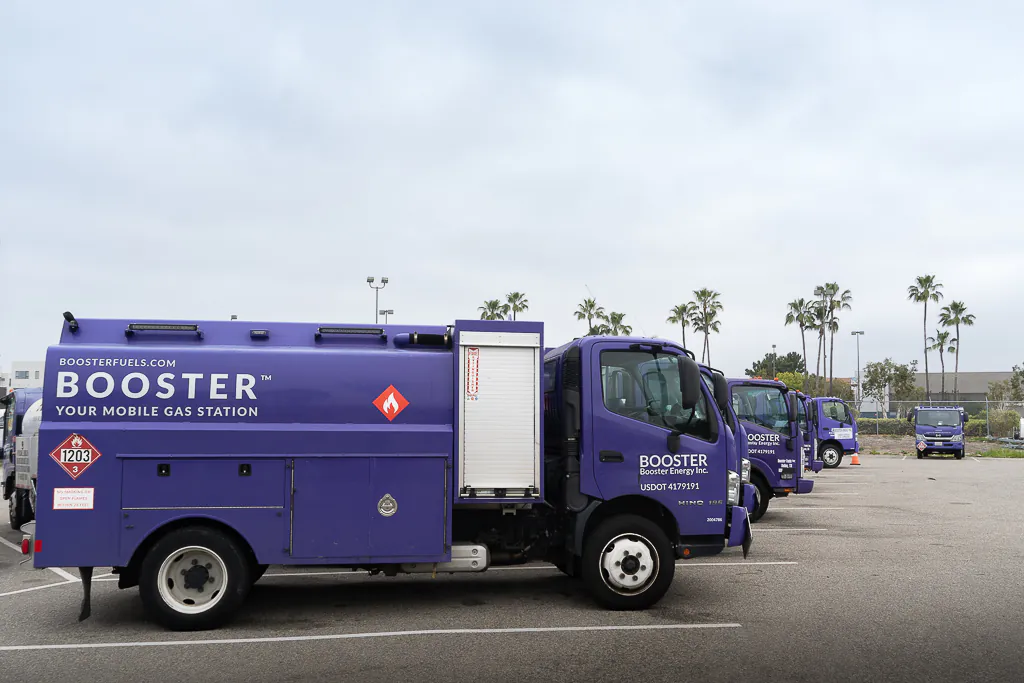
Fleet managers have good reason to be wary when a service provider promises a better way to fuel – and perhaps even more reason to be wary when they’re told it will be “easy.” Most operational upgrades, however worthwhile, arrive with a rollout attached: contracts to sign, equipment to install, and new habits to drill into every driver. By the time a program is fully live, the team has weathered weeks of disruption. They’re tired. They don’t see any immediate benefits. And they miss their old routines.
We built Booster’s onboarding to do the opposite. No multi step process to schedule your order. No staff required on-site at a truck yard to supervise. During onboarding, our customers provide two pieces of information: location access and a list of vehicles to fill. With these in our system, and a dry run night to ensure that access codes work, it’s done. Drivers and fleet managers can get back to work, confident that they will start each day with a full tank.
Booster Is Designed To Be Effortless
When a fleet signs on with a telematics provider or a fuel card program, the real cost is not only the contract. It is the implementation.
- Hardware has to be mounted individually, taking vehicles off the road for hours. That hardware also comes with a learning curve. Drivers and staff have to learn how to use it.
- Fuel cards have to be issued including PIN assignment and policy review so drivers know what can and cannot be charged, and which local stations are already approved and which are off-limits.
Implementation can stretch across months before the new system runs as promised. As a result, fleet managers or operations teams who have lived through one of these rollouts greet each new pitch with caution.
Booster is the rare solution whose onboarding subtracts effort rather than adding it.
- No equipment to install
- No new system for drivers to learn
Getting started means handing off a short set of details once, and then letting drivers do less than they did the week before.
How Booster Makes Onboarding Seamless
The short answer to everyone’s question about how this works: There’s nothing to install on vehicles or in the truck yard. Everything is tracked from our side of the exchange. We measure truck-by-truck fuel usage and fuel spend by logging what moves from our Smart Tankers into our customer’s vehicle. We’ve even simplified vehicle tagging, using the license plate as the identifier instead of a new piece of equipment.
Booster integrates with so many telematics providers, reporting services, and fuel cards that we can work with any set up you have. Fuel cards can be slotted right in. Some customers use their existing card to pay their Booster invoice so they can continue benefiting from fuel card programs. Others find using Booster means they can cut the cost of a fuel card program completely.
After onboarding with Booster, Ryde Transportation saw such an opportunity to streamline, eliminating nearly all of its fuel cards when they saw the jump in productivity that we helped them achieve:
“Booster’s service has been great and has allowed my team to focus on providing an exceptional service for our customers which starts with on-time arrivals. Our drivers no longer have to plan their mornings around which gas stations to visit. I have eliminated almost all of our fuel cards and the increase in productivity has helped us tremendously.”
Because Booster keeps all the tracking and analysis work on our side of the service, the slow adoption curve that stalls most fleet technology projects simply does not apply.
Booster Onboarding 101
Booster needs only two pieces of information to start fueling a new customer:
- An up-to-date vehicle list: Every vehicle a fleet wants fueled goes on a list that lives in their Booster dashboard. If a vehicle is on the list, it gets fueled, even one added shortly before that night’s service window. Because deliveries are matched to that list, the right fuel always goes into the right tank.
- On-site access: Booster confirms access information for every new client, whether that means a gate code or simple entry instructions for the lot. In most markets this is a routine step. This information allows our drivers to enter and complete each fueling.
Note: With only one exception, Booster drivers do not need to access the cab of any vehicle. That exception is for our California clients who are also contracting the Booster team to complete a CARB Clean Truck Check Inspection. For these services, a Booster team member will discuss direct access needs with the fleet manager.
Once we can collect the necessary vehicle list and on-site access information on a handoff call, we set up a dry run delivery test to confirm everything works. If it does, we’re ready to fuel. By launch night, the fleet already knows the process has been tested from end to end.
From outreach to implementation, Booster is easy and efficient with such streamlined onboarding that first fueling can happen in days – not weeks. Just this summer, we were proud to partner with Gen Energy and Hyundai to fuel player and team support vehicles for FIFA’s World Cup in San Francisco, Los Angeles, and Seattle. The window for success was less than one month to fulfill all location needs. Booster was done fueling the needed vehicles in less than 10 days.
Fleet Drivers Start Every Shift Fueled & Ready
From first call to first delivery, our goal stays the same: Help our customers start the day with a full tank, every day. Everything drivers used to do to manage fueling goes away. Booster delivers on-site and around the clock, topping off vehicles during non-operating hours so that every shift starts the same way.
That matters because refueling quietly consumes a startling amount of a fleet’s time. Booster’s own figures show the average vehicle makes 183 refueling trips a year, and those detours add up to roughly 61 hours of lost time and more than $1,500 in labor cost per vehicle annually. Removing the trip removes the drain.
Booster customer GL Pools described the difference plainly: technicians get into their trucks and go, rarely needing to think about fuel, and the team has one less task to check off each week. That is the practical shape of seamless onboarding. Not a new system to manage, but an old chore that disappears.
Getting started is simple. We start with a complimentary analysis of your current fueling statements, followed by a site visit with a Booster energy consultant, and then your first boost, the delivery that puts full tanks and your insights dashboard to work. If your team is ready to make fueling one less thing to manage, reach out for a complimentary fuel analysis.