
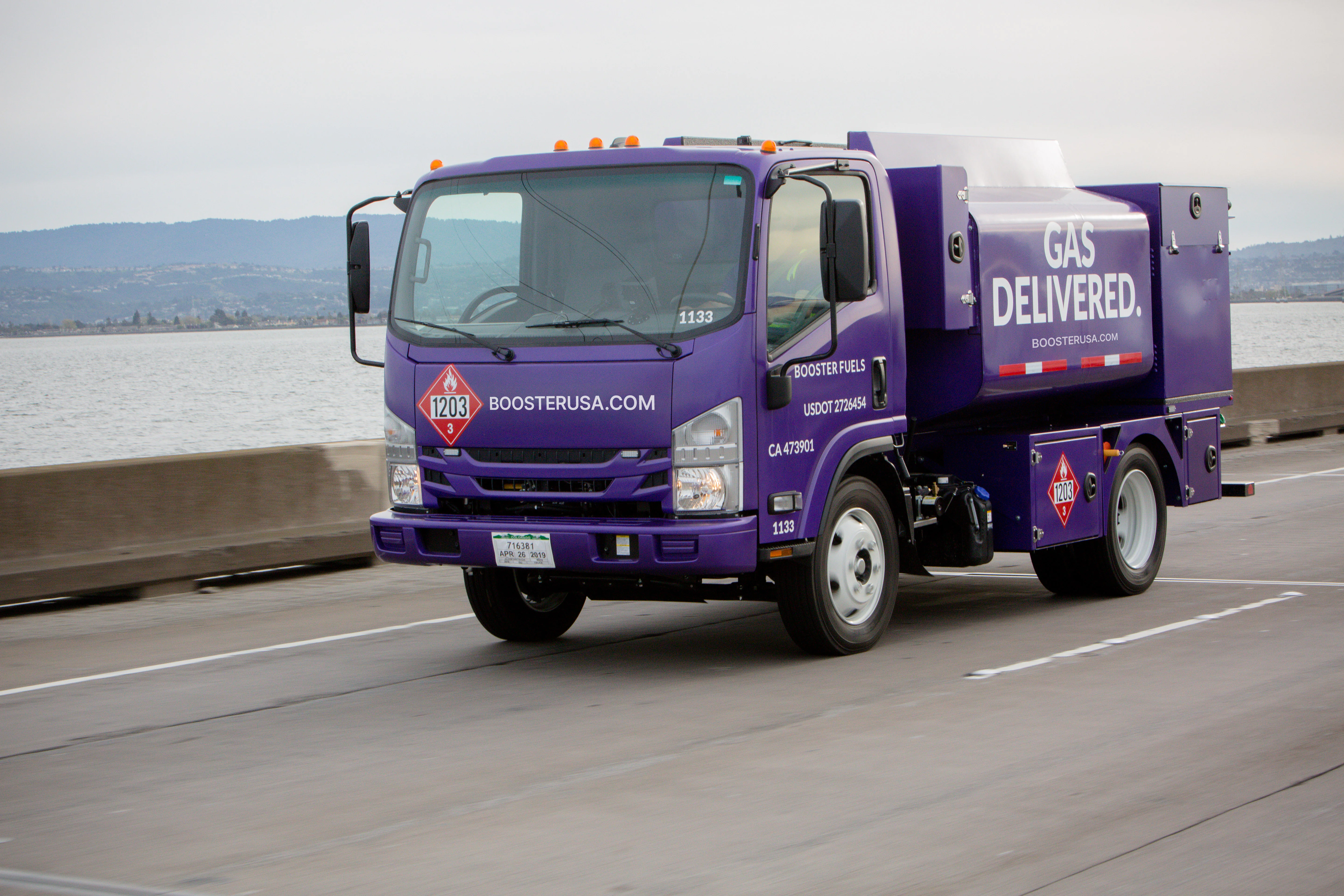
Last week, we followed Booster from a straightforward start in Texas to holding the only CARB certification in California for wet-hose gasoline delivery (read part one here). A small Booster team worked hand in hand with California’s regulators to establish that certification, and it helped define our corner of the energy industry. This week, we dig into all the steps we took to achieve this milestone certification, starting with the very basic question: Is Booster a stationary or mobile fueling source?
Gasoline dispensing is among the most heavily regulated activities in California, and nearly every rule on the books assumed the fuel sat still, in a tank, at a fixed address. Our fuel moves. Because you can’t talk about emissions until you can identify how fuel is being stored, being delivered from source to vehicle, and all the equipment required to do so safely. And classifying an operation that had never existed meant working alongside CARB and several state agencies to build a framework Booster helped write.
What Is a CARB Executive Order?
In the simplest terms, a California Air Resources Board (CARB) executive order is written documentation of compliance. “CARB has this certification called an executive order,” Olamide Golden, Booster’s policy manager, explained. “It’s written documentation of compliance, confirming that the way Booster operates is certified.”
These orders already run quietly through everyday life in California, and most people never realize they help protect their community’s air quality. The same kind of order certifies the vapor-recovery hardware built into new vehicles that captures fuel vapors at every fill-up. In fact, every new car sold in California carries CARB executive orders certifying its emissions hardware. Booster’s mobile fueling operation joined that same certified category with its own executive order, a first for on-demand gasoline delivery in the state.
How Booster’s Mobile Fuel Delivery Created a New Classification in California
Regulators begin with a basic question: Is this a stationary source of emissions or a mobile one? A gas station is stationary. It has a fixed address, fixed infrastructure, and underground tanks, and California’s rules are written around that assumption. Booster is mobile. On the fuel supply side, its tankers are loaded directly from supply terminals – not stored on-site in a Booster lot. On the customer fueling side, Booster’s service professionals drive a tanker on-site, deliver fuel to the assigned vehicles, and then leave. When we started our business, no existing category quite described it.
So CARB evaluated Booster’s mobile fueling on-demand tank vehicle as a “novel facility” under its Certification Procedure CP-205, the pathway CARB reserves for applications that do not fit any established category. In effect, Booster helped write a new chapter of the rulebook, proving that a cleaner, safer way to deliver gasoline needed to have a place in California’s regulations. This took years. We started before the pandemic, collecting all of the necessary data, adjusting and evolving our own technology and procedures to not just meet minimums but to exceed them, and then running these systems against the procedures CARB uses to test innovative systems like ours. We proved that our technology and processes were not adding new emissions to the air. Booster hadn’t just met California’s standards. It had helped define them, and its model is now one of the definitions the state uses to regulate mobile fuel delivery.
How Booster Proved We Weren’t Creating New Emissions
California controls refueling vapors in layers, pairing the recovery systems at stations with the recovery built into modern vehicles, and it kept that layered approach even as other states relaxed theirs. Booster’s task was to prove that dispensing gasoline from a moving tanker into a vehicle adds no new emissions to the air around it.
According to the certification, Booster may dispense gasoline only to vehicles equipped with onboard refueling vapor recovery. The vehicles themselves capture vapors at the moment of the fill, the same way it would at any modern gas pump. Additionally, Booster Smart Tankers are loaded only at terminals with CARB-certified vapor recovery, and only from the bottom, never splash-loaded through an open hatch. This further shows CARB how Booster’s operations do not add new emissions. CARB had to review and confirm the work against these conditions to certify us.
CARB Certification Covers Many Agencies with One Order
CARB exists to protect Californians from air pollution, and pollution can come from the land, the water, and the vehicles in between. So earning an executive order was never a CARB-only exercise. CARB governed the emissions piece, but it required Booster to account for the demand side of the operation as well: Where fuel could spill, how a parking lot drains, and what would happen to soil and groundwater if something ever went wrong.
Earning that first order brought in several agencies, each reviewing a different risk: Fire safety, the transport of hazardous materials on public roads, worker safety, the accurate measurement of every gallon, and the protection of water and groundwater were each reviewed by the agency responsible for it. Every one of those agencies had to be satisfied before the order could be issued, and Booster came ready. The same discipline behind our Perfect Boost commitment, keeping equipment in top condition and records clean, is exactly what regulators want to see. The team met every agency with reports, technical data, and procedures to satisfy any question they raised.
The Certification Has To Match The Equipment
Because every certification layer references the others, the mobile fueling equipment itself has to satisfy all of them at once:
- The fire code sets a capacity limit;
- The CARB executive order specifies the tank;
- The local air-district permits refer back to that order.
Change one, and the rest have to catch up. We encountered this as we diversified our fueling equipment. We wanted to bring on larger tankers which carry more fuel per trip and cut return runs to the terminal, allowing us to more efficiently service larger fleets and busier lots.
Golden described what that looked like when Booster moved to larger gasoline tankers: “The air districts would say, ‘Your CARB executive order shows a picture of a 700/500 split, so that’s all we can issue.'” The 700/500 split she means is Booster’s original 1,200-gallon tanker. Certifying a different tanker, such as the larger 1,600-gallon truck, a two-compartment 1,000- and 600-gallon tank built to U.S. Department of Transportation Specification 406, meant updating the executive order itself so the air districts had a current one to point to. Only then could the fire code, the order, and the district permits all line up behind the bigger truck.
That groundwork is exacting, but it pays off. Once the executive order ratifies a certified truck, districts across the state can permit it, so the hard part is done once and the equipment goes to work everywhere it is recognized. And because no other mobile fueler currently holds this gasoline certification, our certified equipment is an edge competitors cannot shortcut. It has to be earned the same slow, exacting way, every tanker and every time.
This is demanding, precise work, and Booster’s regulatory team does it every day.
How To Successfully Get Recertified
Staying certified in California is not a milestone the company passed once. It is a standard we meet every trip, every day, every year. Certification is not a document that gets filed and forgotten; it is a living commitment that grows as the state’s expectations grow and as the communities Booster serve change. Rules get tighter, equipment advances, and new questions come up in every region. Meeting that moving target means the team is always learning, refining its practices, and raising its own bar to stay in step.
The record shows that work. Booster’s original order, the first of its kind, VR-601-A, was issued on February 19, 2021, updated in 2025. Earlier this year, Booster filed to renew it, and CARB issued VR-601-C, extending the certification through April 1, 2030.
Renewal runs on a multi-year cycle, and it is not automatic. Each renewal confirms Booster’s continued adherence to state requirements and that our operation has successfully evolved wherever it needed to. In fact, CARB reviews found no deficiencies in our operations. Behind that clean result is constant upkeep: Every Booster tanker is tested and certified annually and carries a current CARB decal, and each truck keeps copies of its permits on board, available to the air districts and CARB on request.
That upkeep is not really about paperwork. It is about the people on the other side of it, the neighborhoods, worksites, and cities where Booster operates, who count on every fueling being done safely and cleanly. Keeping the certification current is how Booster keeps that promise, and it is a promise the team recommits to with every truck, every terminal, and every renewal.
If your team is looking for gasoline, diesel, or renewable diesel delivery, reach out to the Booster team to learn about coverage in your state.
This is the second in a multi-part series on how Booster’s regulatory work actually happens: safely, legally, and in new regions as the company grows. Next, we look beyond California at what permitting takes as Booster expands across the country.