
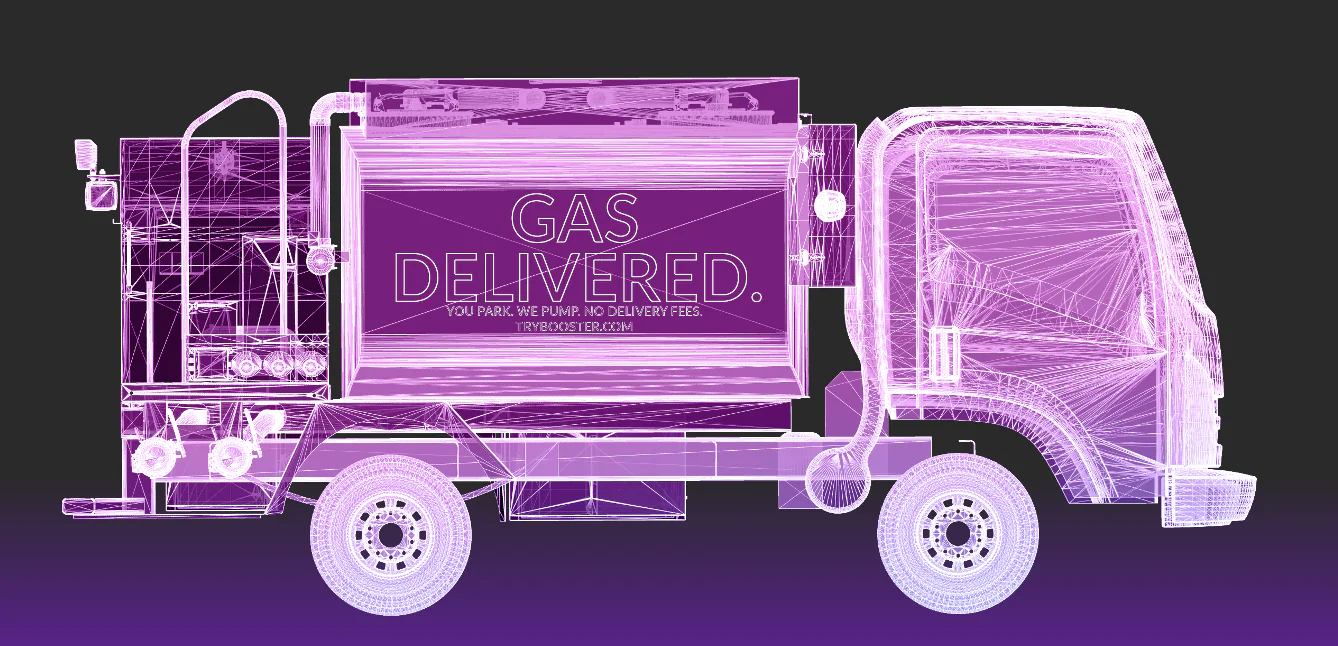
When founders tell their origin story, it almost always starts with a line of code. Booster’s story starts with a little purple tanker truck.
Today, we’re looking back at the tanker that started it all. Before the Fleet Portal, before the telematics integrations, before a single analytics report landed in a fleet manager’s inbox, there was one stubborn problem: getting fuel from the terminal into a vehicle’s tank without a gas station in between. Software couldn’t solve that. Something had to be built first.
Booster now runs a variety of tankers that can fuel just about any fleet. The fuel has changed, and so has the technology. The idea hasn’t: fewer trips, less waste, and a cleaner way to move fuel. A decade later, that little purple tanker remains the clearest expression of who Booster is – a fuel company that learned to write software, not a software company that learned to deliver fuel.
Where Does a Fuel Delivery Company Begin?
Booster launched its mobile fuel service in 2015. The earliest deliveries looked very different from today’s overnight fleet fills. Early customers were commuters who scheduled a fill-up through an app while their cars sat in office parking lots during the workday, with employers opening their lots to the service as a perk for their teams. But we quickly learned that this business model came with a hard engineering constraint: space. A conventional fuel tanker is built to drive open roads, pull through wide gates, and drop thousands of gallons into a gas station’s underground tank, not to weave between parked sedans in a corporate lot. The job called for a different kind of vehicle, so Booster designed one.
Why Would a Fuel Startup Build Its Own Tanker?
Booster’s tanker was designed to navigate the tight lanes of parking lots and to both load fuel at the terminal and deliver it directly to vehicles. That second capability mattered as much as the first. A traditional supply chain moves fuel from the terminal to a station’s underground storage tank, where it waits for drivers to come to it. By carrying fuel straight from the terminal to the vehicle, the tanker removed an entire leg of that journey, preventing unnecessary emissions and saving drivers and their companies time and money.
The design priorities set in those early years still define the Smart Tanker today. The current Smart Tanker fits in a standard parking spot, turns tighter than a Honda Civic, loads at 600 gallons per minute at the terminal, dispenses at three times the rate of a gas station, and carries enough fuel to refuel more than 100 vehicles in a single load. Tank capacity has grown from 1,200 gallons on the tanker certified under Booster’s original California executive order to 1,600 gallons today – more fuel per trip without giving up the compact footprint that made the tanker truck work in the first place.
The approach scaled quickly. By 2019, Booster was running roughly 70 mini tankers and had completed more than 2 million fuel deliveries across more than 20 cities. Today, Booster’s fleet includes a variety of tankers, fueling everything from local service providers like landscapers and emergency medical fleets to the national delivery and logistics companies that keep packages moving.
What Made a Tanker Truck Cleaner Than a Gas Station?
The Smart Tanker’s environmental case was built into its logic from the start. One tanker making a scheduled delivery replaces a long line of individual vehicles, each making its own trip to the pump. Taking the gas station out of the supply chain also takes the underground storage tank out of the picture, which Booster has long identified as a risk to community land and water.
The proprietary fueling system mattered too. A May 2019 ALG Environmental study found that Booster’s supply chain and fueling system reduced emissions of volatile organic compounds by 26% compared with retail gas stations. Those are the compounds behind the haze and smog that settle over cities. By that same year, Booster estimated it had prevented the release of more than 2.32 million pounds of carbon by eliminating gas station trips, everyday station spills, and the need for underground storage.
Every Smart Tanker carries Booster’s Eco-Nozzle, which reduces vapor emissions on every boost and supports compliance with onboard refueling vapor recovery (ORVR) standards. Each tanker is also equipped with an automatic shutoff nozzle and a 30-gallon fuel-limit switch, and is certified for overturn spill protection under NFPA 385. Those features work hand in hand with the Perfect Boost, Booster’s spill-prevention standard for every delivery.
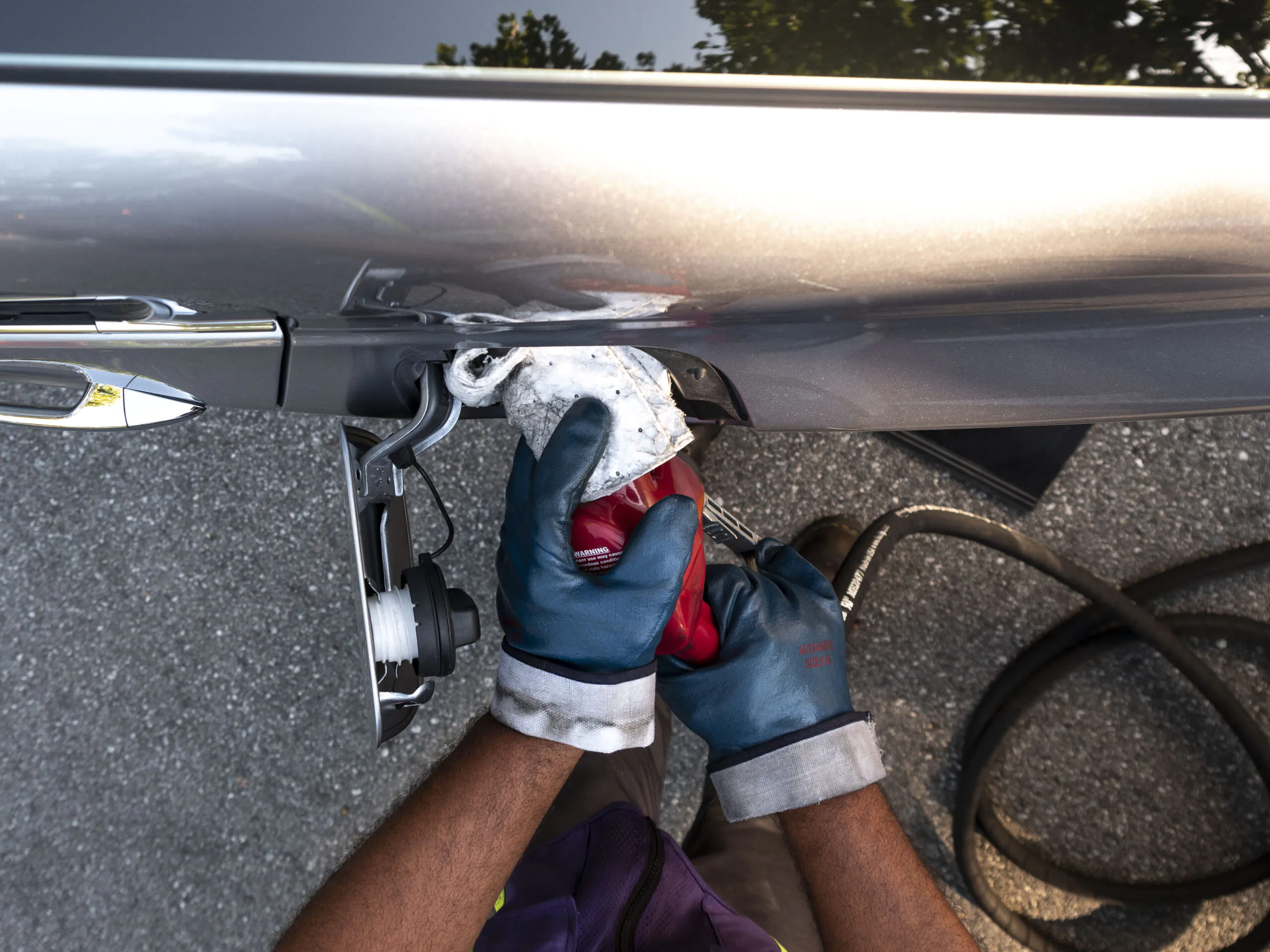
That engineering has been validated by California’s air regulators. On February 19, 2021, the California Air Resources Board issued Booster executive order VR-601-A. In April 2026, CARB renewed it as VR-601-C, valid through April 1, 2030.
How Did a Tanker Become a Technology Platform?
The Smart Tanker has never been just a container on wheels. Booster’s engineering team describes a technology stack that runs across the cloud, the edge, and the tanker itself, with a fuel nozzle as its final mile. As Booster Engineering puts it, “We move atoms, not just electrons.”
Every tanker gathers data as it works: boosts per vehicle, fuel type, gallons and pricing, real-time GPS location, a map of where each vehicle was fueled, and the reason any vehicle was skipped. That data flows in real time to Booster’s operations center and into each customer’s Fleet Portal. Cloud connectivity, IoT and telematics integrations, and dynamic routing are built into the tanker.
The same telematics keep Booster’s own fleet running lean. Booster monitors its tankers for speeding, hard braking, and abrupt acceleration that drag down fuel economy, flags vehicle health issues like tire pressure and idling through fault code notifications, and uses GPS-enabled routing to cut miles traveled each night. New tanker and component purchases are reviewed against sustainability and safety requirements that include clean idle technology and quiet operation.
The data and learnings we collected from our first Smart Tankers became the foundation for the future. With that experience and information we built both the dashboard fleet managers rely on today and the BoosterOS software we’re now sharing with fellow fuel marketers.
When Did the Tanker Start Carrying Renewable Diesel?
Because the Smart Tanker carries fuel straight from the terminal to the vehicle, it can carry the fuel a fleet actually needs, including fuels that are rarely available at gas stations. That flexibility turned the tanker into a delivery vehicle for the energy transition. By 2022, renewable diesel was already a fixture on Booster’s routes, with 100% of the greener fuel flowing to thousands of fleet vehicles across California, some of them running on fuel made from recycled used cooking oil.
Over the last ten years, Booster has helped hundreds of customers move from conventional diesel to renewable diesel, and nearly all of its fleet clients have made the switch in markets where renewable diesel is available. Today’s Smart Tankers can deliver multiple fuel types in a single trip, so adding a lower-carbon option to a fleet’s rotation does not add a second delivery.
What Does the Next Decade Ask of a Fuel Company?
Expectations for fuel suppliers have changed a great deal since the first purple tanker pulled into a parking lot. Communities, customers, and regulators are asking harder questions about how fuel moves and what it leaves behind. Booster’s answer has been in the tanker all along: fewer trips to the pump, fewer vapors released, fewer spills, no underground tanks, and cleaner fuel wherever it can be sourced.
Ten years later, Booster is not just delivering fuel. Through BoosterOS, fuel marketers and distributors nationwide now get the delivery planning, route building, and driver technology Booster spent a decade refining on its own fleet. Partners can also train on Booster’s safety and compliance standards, carrying the same discipline that started with one tanker into fleets Booster has never fueled itself. It all serves one simple goal: to bring the Perfect Boost to everyone.
The fuel in the tank has evolved, and so has the technology riding along with it. The commitment has not. Stewardship was never a feature added after the fact at Booster. It was engineered into that very first little purple tanker.
Want to see the Smart Tanker – and the decade of engineering behind it – at work in your own yard? Reach out to a member of our team for a complimentary fuel analysis.