
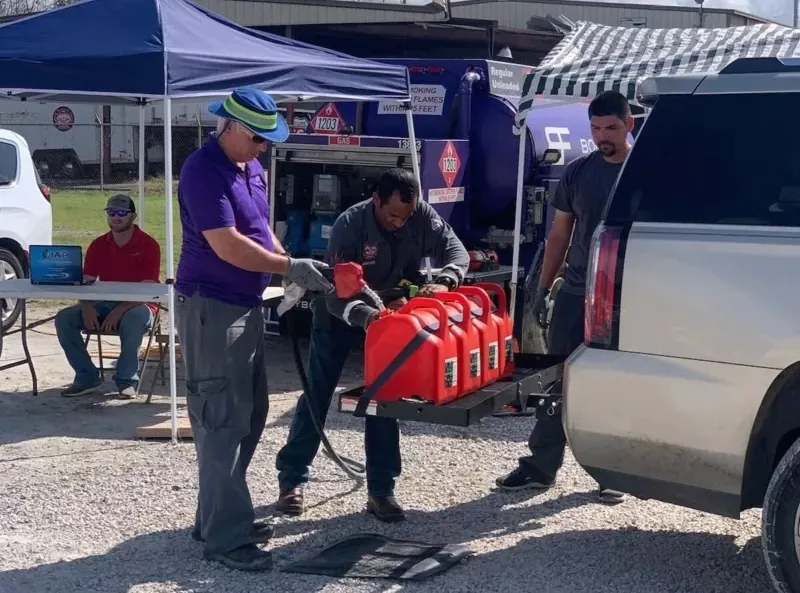
Fleets plan for almost everything: routes, maintenance schedules, driver coverage, spare parts. Fuel is the exception. It often sits in the background as a reliable utility right up until a wildfire, hurricane, or winter storm turns it into the single point of failure that can stop an entire operation. The fleets and agencies that treat fuel access as part of their emergency planning are the ones that keep moving when everyone else is stranded in line at an empty gas station.
That planning matters more every year. In 2024, the United States recorded 27 separate billion-dollar weather and climate disasters, and while the country averaged nine such events per year between 1980 and 2024, the average across the most recent five years has climbed to 23, according to NOAA. The disruptions that once felt exceptional are now an annual planning assumption.
What Happens to Fuel Access When a Disaster Hits?
Shortages often begin before storms do. As residents evacuate and top off the tanks in their personal vehicles, retail demand spikes days ahead of landfall. During Hurricane Irma, nearly 20% of gas stations in Gainesville, Florida, were already reported empty before the state’s emergency declaration was even announced. Once a storm arrives, the numbers climb fast: roughly 62% of stations in the hardest-hit Hurricane Michael area reported no fuel, a level that held for days after landfall, and outages reached as high as 70% in Wilmington, North Carolina, during Hurricane Florence.
The problem is rarely a lack of fuel in the country. It’s a lack of fuel where and when it is needed. Florida, for example, has no in-state refineries and no major supply pipelines, so nearly all of its fuel arrives by ship. When ports close ahead of a storm, the pumps have no way to refill. Damaged stations, road closures, and widespread power outages then keep even undamaged stations offline. Why? Because a pump without electricity cannot dispense fuel.
Why Can’t the Traditional Fuel Supply Chain Keep Up?
Booster has watched this pattern repeat across a decade of disaster response. When a state of emergency is declared, demand surges at the same moment that stations are damaged or knocked offline, and the traditional fuel supply chain is too slow to respond and close the gap. The result is predictable: Cars line up for miles at the few stations with both power and product, and relief efforts are slowed by the very fuel they depend on.
Winter storms make the point even sharper, because they can take out fuel and power together. When Winter Storm Uri hit Texas in February 2021, more than 4.5 million homes and businesses lost power in the largest controlled blackout in U.S. history, driven in part by natural gas supply failures at the wellhead and at processing facilities. A grid-down freeze does not just close gas stations; it can idle the diesel-powered generators that hospitals, shelters, and businesses rely on to ride it out unless that fuel is delivered directly.
What Does a Fuel Security Plan Actually Look Like?
A fuel security plan replaces the assumption that fuel will be available with a guarantee that it will be delivered. The U.S. Fire Administration and FEMA put the stakes plainly in their joint disaster-response guidance: When logistics fail and fuel, food, and other supplies are slowed down, tactical operations often grind to a halt. For a fleet or an agency, building that logistics backbone ahead of time means arranging a few things before the season starts:
- On-demand mobile delivery: A pre-arranged agreement so fuel comes to the vehicles and equipment, rather than sending crews to hunt for open stations.
- Generator fueling: Coverage for the backup power that keeps facilities, shelters, and cold storage running through an outage.
- Fuel flexibility: Access to both gasoline and diesel (and renewable diesel where available) so a plan is not derailed by a shortage of one fuel type.
- Rapid, technology-driven dispatch: The ability to size and route the right tanker to the right site quickly when conditions change by the hour.
Booster’s on-demand fuel delivery is built to deploy into exactly these conditions, prioritizing equipment and fuel in real time so the right tanker can be on the ground and pumping in the shortest time possible.
Has Mobile Fuel Delivery Been Tested in a Real Emergency?
Mobile fuel delivery has repeatedly answered the call for emergency fuel delivery, and under some of the most demanding conditions in the country. Here’s a look at the times Booster has been called in to help at the last second.
Booster Fights Fire With CAL FIRE
When the California Department of Forestry and Fire Protection (CAL FIRE) battled the roughly 600-acre Border 13 fire near San Diego in June 2022, Booster was already under a mobile-fueling-on-demand agreement signed less than three months earlier.
In fewer than 12 hours post-call for help, Booster dispatched a 2,800-gallon tanker of clear diesel from its Orange County yard to the command center. Over the next 37 hours, a rotating team of four Service Professionals pumped approximately 1,000 gallons to nearly 50 vehicles – from CAL FIRE engines to the contracted bulldozers cutting fire breaks – on a tanker that CAL FIRE had precertified for active fire incidents.
“This live fire incident was a great example of Booster’s ability to respond quickly to these types of disaster events, which will become more critical as we continue to deal with increasingly devastating wildfires here in California,” said Mark Philipp, Booster’s Operations Manager for Southern California.
Helping the Helpers After Hurricane Laura and Hurricane Ida
The same model has supported communities well beyond the fire line. After Hurricane Laura left the Lake Charles, Louisiana, community without electricity, cell service, or working gas stations in 2020, Booster’s team fueled first-responder and personal vehicles and kept generators running in local homes, hotels, and businesses.
A year later, following Hurricane Ida, roughly two-thirds of gas stations in Baton Rouge and New Orleans were without fuel, and Louisiana’s governor reported that fuel shortages were hampering recovery. Booster partnered with a national grocer to keep food-delivery drivers on their routes rather than stranded in fuel lines. That work follows a longer track record that includes fueling FEMA vehicles after Hurricane Harvey in Texas and supporting relief during the Nashville tornado and California’s rolling blackouts.
How Can a Fleet Get Ahead of the Next Emergency?
Yes, fleet managers and small businesses can be prepared for the worst-case scenarios with good partners. The time to build a fuel security plan is before the watch turns into a warning. If your team depends on vehicles, equipment, or generators that cannot afford to sit idle during a wildfire, hurricane, or winter storm, Booster can help you put emergency fuel delivery in place now. Make fuel one less thing to worry about when the next disaster hits. Learn more about Booster’s emergency fuel delivery and reach out to our team to build a plan for your fleet.