
Local road wear is one of those quiet, compounding costs that rarely shows up on a single invoice but eventually appears in every fleet manager’s budget – and every community’s tax bill. Pavement deteriorates with every axle that passes over it. Vehicles deteriorate with every rough mile driven. In U.S. communities where commercial traffic has grown faster than infrastructure funding, those two trends collide.
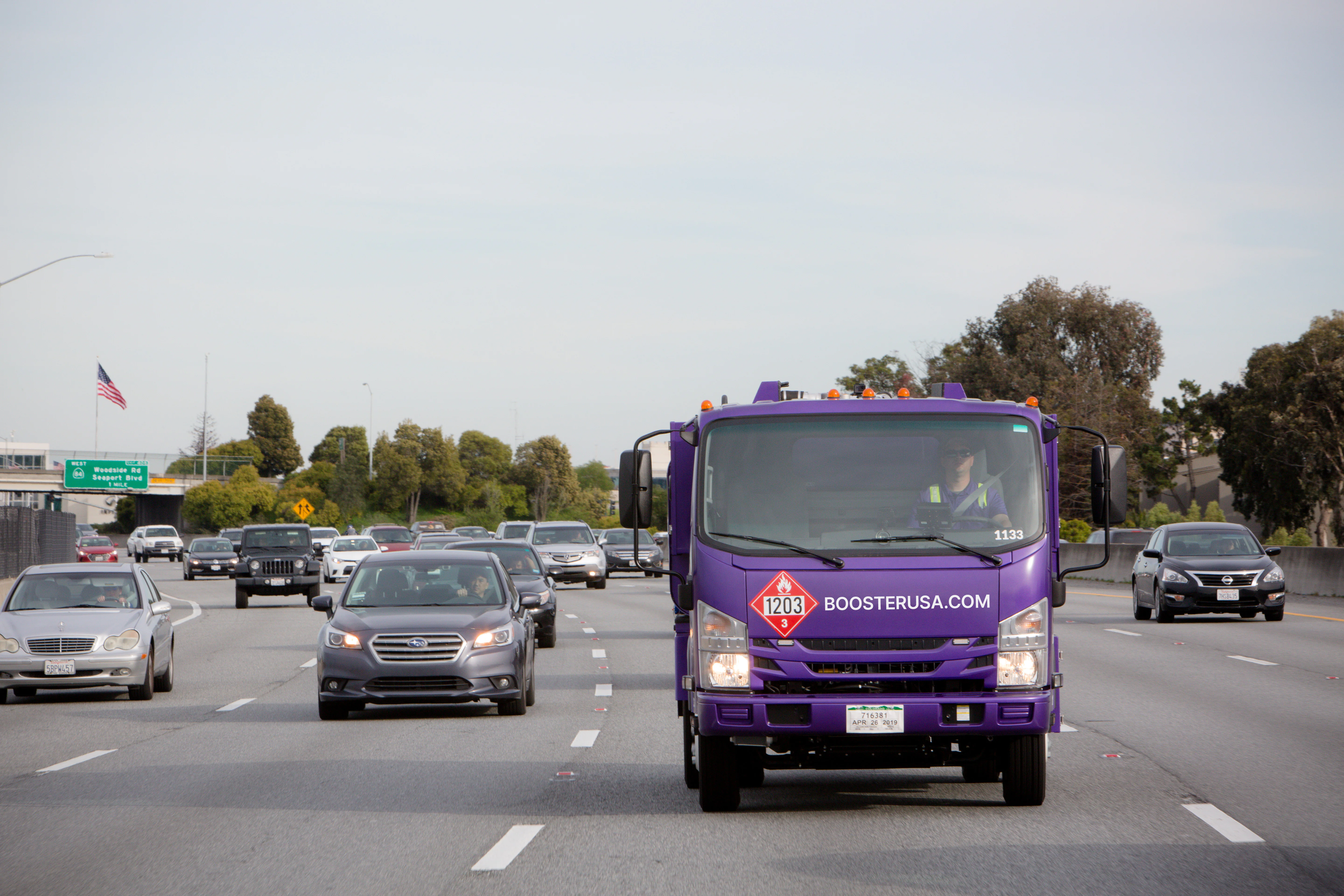
Mobile fuel delivery from Booster can’t fix a community’s road maintenance backlog. But by eliminating hundreds of refueling trips per fleet vehicle each year, it removes a meaningful share of the unnecessary miles that drive wear and tear – for fleets, for roads, and for the communities where fleets operate.
The True Cost of Driving on Deteriorating U.S. Roads
The American Society of Civil Engineers’ 2025 Infrastructure Report Card gave U.S. roads a “D+” grade, with roughly 39% of major roads in poor or mediocre condition. Driving on those roads costs the average American driver more than $1,400 a year in vehicle operating costs and lost time, with $725 of that figure attributable to extra vehicle operating costs alone, including accelerated tire wear, more frequent repairs, premature depreciation, and higher fuel consumption.
Congestion adds another layer. INRIX’s 2024 Global Traffic Scorecard found that the average American driver lost 43 hours to congestion in 2024, costing $771 per driver in lost time and productivity and more than $74 billion nationally. In Los Angeles, the third most congested U.S. city, drivers lost 88 hours, costing $1,575 per driver. And that’s just the time-and-fuel side of the cost. The pavement itself takes a different kind of hit.
How Large Fleet Trucks Affect Local Roads
When pavement engineers calculate road wear, they don’t count every vehicle equally. They use a measure called the Equivalent Single Axle Load (ESAL), which standardizes the damage different vehicle types inflict on pavement.
According to Pavement Interactive, a typical passenger car contributes roughly 0.003 ESALs per pass, while a fully loaded tractor-semi trailer contributes up to 3 ESALs, roughly a thousand times the pavement damage of a passenger car. Real-world highway data suggests a single pass of a 5-axle semi-trailer can equal between 1,750 and 2,925 passes of a typical car, depending on highway class.
It’s not that trucks shouldn’t be on the road, but every unnecessary heavy-vehicle trip a fleet eliminates has a disproportionate impact on local roads and on the vehicles themselves. Every trip is wear on the truck, more frequent repairs, and faster depreciation, and rough roads accelerate all of it. Heavy trucks have an outsized effect on local pavement, and extra trips to retail fueling stations have an equally outsized effect on fleet budgets.
Refueling Trips Add Hundreds of Miles to Fleet Vehicles and Real Costs to Local Roads
Telematics provider Geotab found that the average fleet vehicle drives roughly 2.2 off-route miles for every trip to a gas station. Booster’s customer data shows that the average fleet vehicle requires around 183 refuels per year. That works out to roughly 403 unnecessary miles per fleet vehicle annually – miles that exist solely to acquire fuel.
Across a fleet of 20 vehicles, that’s more than 8,000 unnecessary miles each year. Across 100 vehicles, more than 40,000. Each mile adds to local congestion, local pavement wear, and the operating cost of the vehicle making the trip. Across an entire fleet, the off-route miles spent chasing fuel become one of the clearer line items in the true cost of fueling – and one of the more visible ways a fleet contributes to local pavement wear.
How Mobile Fuel Delivery Removes Trips From Local Roads
Federal investment under the Infrastructure Investment and Jobs Act has put more than $591 billion into U.S. infrastructure since late 2021, according to the ASCE 2025 Infrastructure Report Card. Even so, the backlog of needed road and bridge work remains large in many markets. Fleets can’t close that gap, but they can cut back on how they are adding to it.
Booster’s Smart Tankers can fuel up to 100 vehicles in a single delivery cycle, replacing dozens of individual fueling trips with one scheduled delivery. For every Smart Tanker on the road, there can be up to 100 fewer fleet vehicles driving to a gas station that day. The arithmetic is simple: fewer trips equals fewer miles equals less wear, on the vehicle and on the road.
Booster’s customer data estimates that switching to mobile fuel delivery saves roughly 13 gallons of fuel per vehicle per year from eliminated refueling trips and prevents approximately 587 pounds of CO₂ emissions per diesel vehicle annually. The same dynamic that lowers emissions also slows the wear on local roads: fewer engine starts, fewer cold-running miles, and fewer trips through congested corridors.
Community Benefits Compound as More Fleets Switch to Delivery
A single fleet switching to mobile fuel delivery removes a few thousand vehicle-miles from local roads each year. When multiple fleets in the same market do the same thing, those reductions stack.
A Johns Hopkins School of Advanced International Studies (SAIS) practicum found that, in California’s Bay Area alone, mobile fueling could reduce annual carbon dioxide emissions associated with a typical gas station from 97 to 76 metric tons. That’s a 22% decrease per location. The pavement-wear corollary follows the same logic: fewer fleet vehicles making fuel runs means fewer heavy vehicles competing with commuters during peak hours, and fewer heavy-axle trips contributing to the wear figures TRIP and ASCE track each year.
Our analysis of customer data frames the fleet-level savings at roughly $2,000 per vehicle per year in hidden refueling costs across labor, fuel, maintenance, depreciation, and fraud exposure. The community-side benefit is more diffuse but real: fewer fleet vehicles on local roads during rush hour, and fewer heavy-vehicle trips contributing to the cumulative wear that local taxes pay to repair.
Choosing more efficient fueling is one of the structural ways commercial traffic can reduce its own contribution to community emissions and pavement wear. The same operational change that saves a fleet money on labor, depreciation, and fuel also eases traffic and slows the physical wear on community thoroughfares.
If your team is curious how mobile fuel delivery would change the math for your fleet – both the per-vehicle savings and the broader operational picture – reach out to a member of our team today. We can walk through what switching to on-site delivery would look like for your routes, your vehicles, and your neighbors.