
Fuel is the line item every fleet manager can point to as a weight around their neck. But there is a second fuel cost that never lands directly on a statement: the time it takes to get the fuel in the first place. Every trip to the gas station pulls a vehicle off its route and a skilled employee from the work they were hired to do. Those minutes don’t generate revenue, don’t serve a customer, and don’t surface anywhere a manager can easily see them – which is exactly why they accumulate unchecked and float through your budget like a ghost.
Booster was built on a simple conviction: a fleet’s people and equipment are most valuable when they’re doing the work that matters, not idling in a fuel line. Mobile fuel delivery turns that conviction into hours returned to the business. With skilled labor harder to hire and fuel prices climbing steadily, those returned hours are worth more than they have been in years.
How Booster Gives Fleets Time Back
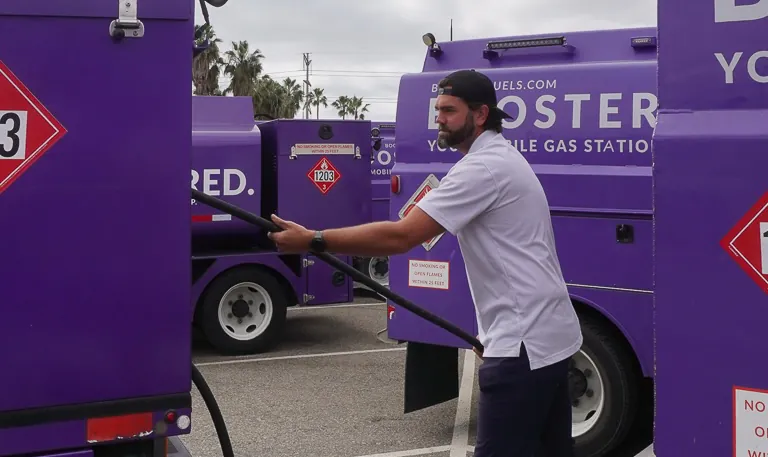
Booster’s answer is to remove the fueling trip entirely. On-site fuel delivery brings gasoline, diesel, and renewable diesel directly to your lot where vehicles are parked when your vehicles aren’t needed on their routes. Fueling happens during non-operating hours, so drivers arrive to full tanks and pull straight onto their routes – no detour, no line.
Customers describe the difference in concrete terms.
- A Booster pool-service operations customer reported that the service saves 20 to 30 minutes per vehicle each week, freeing technicians to focus on the work clients actually pay for.
- A transportation customer eliminated nearly all of their fuel cards and credited the resulting team productivity gains with helping the team hit on-time arrivals more reliably.
- Finally, one large passenger-transport fleet we work with measured 3.2% of total employee time recovered after switching to delivery – the kind of fleet-wide percentage that, at scale, adds up to full positions’ worth of productive capacity.
That is the value sitting underneath the convenience: not just an easier morning for drivers, but capacity returned to a business that needs every productive hour it can find. Removing the pump from the daily routine isn’t a perk – it’s an operating advantage that shows up in on-time performance, in payroll efficiency, and in the simple fact that skilled people spend their day on the work only they can do. Let’s unpack how it all adds up.
Every Second Drivers Spend at the Pump Adds Up for a Fleet
Most fleets think of refueling as a rounding error – a quick stop, a few minutes, back on the road. The data tells a different story. Think about the last time you personally took a road trip. GoogleMaps told you one time estimate but inevitably it took an hour longer. Now consider how many times you stopped for gas. How much did it really cost you? When you allow the example to grow from one driver to a team, and the vehicle to change from a passenger car with a 12-16 gallon tank to a tanker truck that carries 100-150 gallons of fuel at a time.
According to our research, the average fleet vehicle makes 183 refueling trips a year, and each one costs roughly 20 minutes: about 8 minutes of driving and 12 minutes at the station. Multiply that out and a single vehicle loses 61 hours every year just getting fuel – more than a full week and a half of working time spent standing at a pump or driving to one.
That figure compounds in two directions. It multiplies across every vehicle in the fleet, and it multiplies again whenever more than one employee rides along on the detour. Geotab’s research adds another wrinkle: 85% of vehicles still have half a tank when drivers stop to refuel, which means a large share of those trips weren’t even necessary yet. The time loss isn’t just real – a meaningful portion of it is avoidable.
The Real Cost of Fueling at the Station
Hours translate directly into dollars. Our cost analysis puts the national average wage across its customer base at $25.24 an hour. At that rate, a single 20-minute fuel trip burns about $8.41 in labor – and across 183 trips a year, that adds up to more than $1,540 per vehicle annually in wages alone, assuming just one employee per trip. For a modest fleet of ten vehicles, the labor cost of self-fueling clears $15,000 a year before a single gallon is even paid for.
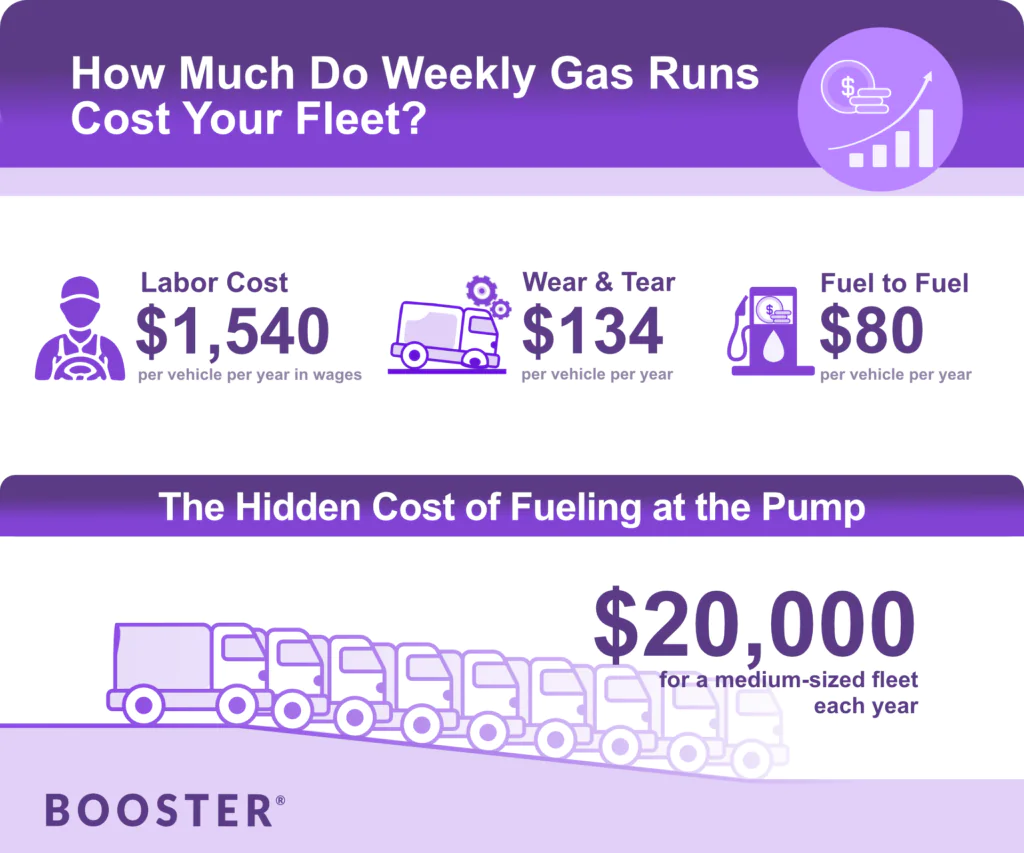
Labor is only the most visible layer. When the full cost of the refueling routine is broken down, a single vehicle quietly absorbs roughly $2,000 a year – close to $20,000 across a fleet of ten:
- Labor: more than $1,540 per vehicle per year in wages spent fueling rather than working.
- Wear and Depreciation: about $134 per vehicle per year, drawing on AAA cost data applied to the extra miles driven to and from the pump.
- Fuel to get Fuel: roughly $80 per vehicle per year burned simply reaching the station and returning.
Time is the entry point. The rest of the costs cascade from there.
Time Savings Matter More Amidst 2026 Instabilities
Two pressures are converging this year to make reclaimed time especially valuable.
The first is labor. The skilled-trades and field-service roles that staff most local fleets – landscaping crews, service technicians, delivery drivers – are getting harder and more expensive to fill. Fewer young workers are considering trade-specific professions as long-term employment opportunities. Meanwhile, experienced workers are getting older and considering retirement. And those in between (employees with skills and years left to work) are the most likely to be poached by competitors. JLL’s 2026 skilled-trades talent research estimates as many as 2.1 million skilled-trades jobs could go unfilled by 2030s. Many operators are raising pay to compete, which makes every working hour they’re paying for that much more valuable.
When a technician or driver is hard to hire and costly to keep, the time they spend idling at a pump isn’t just unproductive – it’s scarce, expensive labor spent on a task that doesn’t require their skills at all. At the $25.24 average hourly wage across Booster’s customer base, every refueling detour is paid time that could have gone toward the billable, customer-facing work these businesses are already struggling to staff.
The second pressure is fuel prices themselves. After opening the year relatively calm – the U.S. Department of Transportation pegged January 2026 averages at $2.81 for regular gasoline and $3.52 for diesel – prices climbed sharply through the spring. By mid-May 2026, the Energy Information Administration reported national averages near $4.49 for gasoline and $5.60 for diesel, with the West Coast running well above that. The fuel market’s volatility makes every opportunity to save vital to your bottom line. And when you align the number of gallons of fuel you waste with the cost of those gallons, every trip to a retail fueling station comes with a price tag you cannot ignore.
Put together, scarce labor and expensive, unpredictable fuel mean the hours lost to refueling aren’t a fixed nuisance to be tolerated. They’re a growing liability worth eliminating.
Time Saved Equals Meaningful Savings for Your Team
The hours lost to fueling don’t all belong to drivers. Managers and finance teams spend their own time reconciling fuel card activity, chasing discrepancies, and stitching reports together from systems that were never designed to talk to each other. Our customer portal consolidates that work into a single 360° view – total gallons, total spend, vehicles serviced, and labor hours saved, broken out by location and by time period.
Because our customer portal surfaces metrics like labor hours saved and miles reduced directly, the time Booster returns becomes something a manager can see and report on rather than a benefit they have to take on faith. Customizable reports can be scheduled to arrive weekly, monthly, or quarterly, removing the manual assembly that used to consume back-office hours. Transparency and reliability aren’t add-ons here – they’re how Booster turns a fueling service into operational intelligence that gives leaders their attention back alongside their drivers’ productivity.
Reclaim the Hours Your Fleet Is Losing
The pump has always charged fleets twice: once for the fuel, and once for the time it takes to go get it. In 2026, with labor scarce and prices volatile, that second bill is the one most worth eliminating. Next week, hear more about the specific savings you could see from Booster team member Rick Gerding, our partnerships development manager working with fueling clients in the Pacific Northwest and software customers across the country. When Rick joined Booster, he brought with him a decade of owner-operator experience in construction and a unique understanding of the challenges fleet managers face every day: teams running late because they had to fill up, again, and costly maintenance fees that could have been avoided with a service like ours. In our next newsletter, we’ll examine the solutions he’s bringing to our Pacific Northwest customers as our team expands in that region. Be sure to subscribe so that you get our next issue in your inbox.